
How Ix works
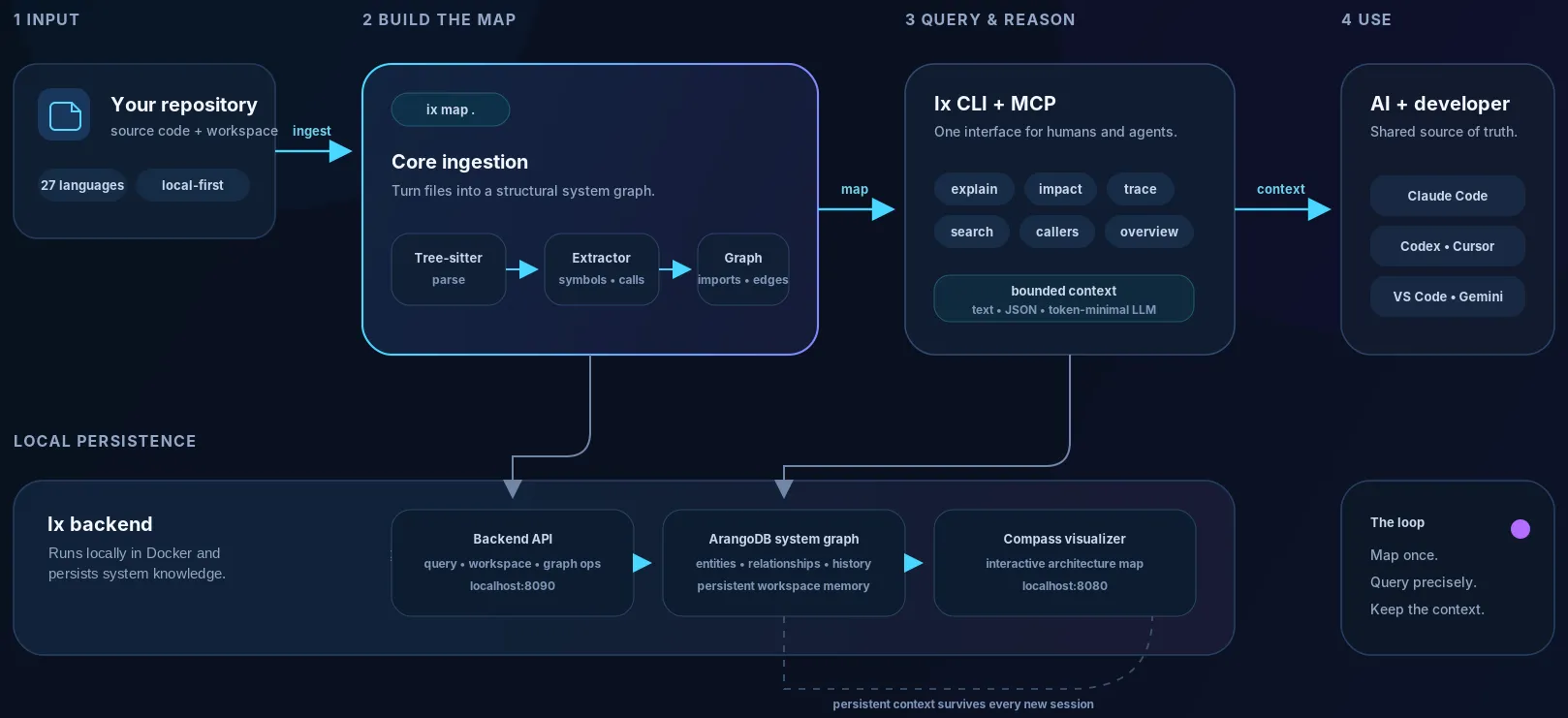
Mapping
Section titled “Mapping”ix map parses your repository with tree-sitter, extracts symbols, calls and
imports, and writes them to the graph as nodes and edges: what calls, contains and imports what. The parser covers
27 languages.
Mapping is incremental. Re-running ix map refreshes the graph. ix watch re-maps on every file change, and the
editor plugins re-ingest a file shortly after you edit it.
The local backend
Section titled “The local backend”The graph is stored in a backend that runs in Docker on your machine:
| Service | Port | Role |
|---|---|---|
| Ix Memory Layer | 127.0.0.1:8090 |
The HTTP API every client talks to |
| ArangoDB 3.12 | none (Compose network only) | The graph database behind it |
The memory layer binds to localhost only and ArangoDB publishes no port at all, so with the default local backend your code and graph stay on your machine. The backend ships as a released Docker image
(ghcr.io/ix-infrastructure/ix-memory-layer). Start it with ix docker start and check it with ix status.
Three clients, one graph
Section titled “Three clients, one graph”| Client | Who uses it | Start it with |
|---|---|---|
ix CLI |
You, and agents that run shell commands | ix <command> |
ix mcp |
AI clients that speak the Model Context Protocol | ix mcp install registers it |
| Compass | You, in a browser | ix view |
All three share the same HTTP API. The graph is the same whichever client reads it: an answer your
agent gets through MCP matches what ix explain prints in your terminal.
Workspaces
Section titled “Workspaces”Every repository you map is its own workspace in the shared backend. Commands run from inside a repository
answer from that repository’s graph. ix view --all shows every mapped workspace together.
Bounded answers
Section titled “Bounded answers”Query commands return bounded answers. They cap result counts, walk depth and output size, and they report what they cut:
ix dependsandix tracestop at depth 3 and 100 nodes.truncated=truemeans the node cap dropped nodes, anddepth_limited=truemeans the walk stopped descending.ix read <file>stops at 400 lines and tells you the range of the next page.ix contextbudgets its evidence in tokens (3,000 by default).
Every limit can be raised with a flag. See the flag reference.